
Sarah Barnsley and Charlotte Gann discuss DIY publishing.
Sarah Barnsley: Congratulations on your third collection, Orange Cats, just out with your own Late Train Press. I’m especially intrigued by how this one has come into the world because, as you know, I’m currently spending a lot of time thinking about Leonard and Virginia Woolf’s’ ‘DIY’ Hogarth Press as part of my writer’s residency at the University of Reading.
The Woolfs were motivated, in the first instance, to print and share their work informally amongst friends, printing their first work (a booklet called Two Stories) from the dining room table in 1917. Of course part of its importance was a kind of freedom it bestowed on Virginia Woolf, who famously said she was ‘the only woman in England free to write what I like’. What motivated you to set up Late Train Press and publish Orange Cats?
Charlotte Gann: Thanks so much for this, S. Love to think about it in parallel with the Woolfs and Hogarth Press! And congratulations on your writer’s residency – do hope it’s all going well.
And yes, freedom has to be the simple answer. Freedom to publish what I wanted, how I wanted and when I wanted.
I found I was feeling increasingly listless at the prospect of submitting to publishers. Then it slowly dawned on me that what I actually wanted was to make my own book. It took me by surprise as the idea arrived out of nowhere.
The thing about ‘informally amongst friends’ also resonates. Orange Cats is a book I wanted to produce to quietly ‘leave’ behind, in my little stack of the books I wrote. I wanted it to exist, as a physical object. And so I made it.
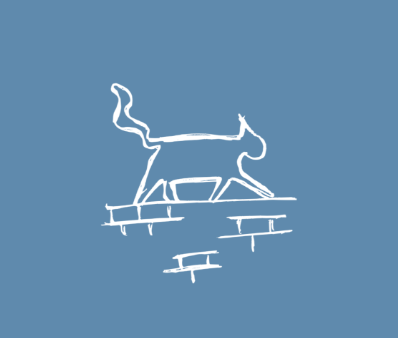
SB: So the book is rather an embodiment of the ‘ginger cat […] creeping’ along the wall of the speaker’s father’s garden in the title poem, which the father relates in a letter? So quiet and yet an ‘image that stays’ providing enduring comfort?
It seems as I write that the book is also to be shared ‘informally amongst family’. Am I right?
CG: Certainly that’s an element at the heart of the project. What images endure? How do we pass on comfort? (Usually, I suspect, unknowingly.)
The timing felt right, as I pulled the book together. I’m at a pivotal age in my own life. A bit like being on a bus and passing a gap in the trees where you can suddenly see where you are more clearly?
I felt compelled to try to capture and share a glimpse of this view.
I’ve dedicated the book to ‘my family’. And of course there’s something inherently informal about publishing one’s own book… But my ongoing exploration in writing is in balancing clarity with restraint. That continues. And I do hope there’s plenty of room in this book for other readers.
SB: I love that image of the bus and passing a gap in the trees, offering clarity. There are so many journeys here (including on the bus from my own London stomping ground, the W7!), and yet as well as clarity there’s also this fragility; that what is glimpsed is also provisional, momentary, and just out of reach. This is captured for me most strongly in one of the last poems of the book, ‘Panel in the Graphic Novel’, where the speaker captures, in her mind, the image of two friends walking along a street. ‘What passes between you is not for me / to know’, you write, before a telling image of the friends as ‘Pen silhouettes / moving away’. I’d say many of the poems here are ‘pen silhouettes’ – and yet, like in the poem, there’s some ease in this, too. Kind of like the ease with which you’ve quietly made (literally) this book! Is this also part of your ‘pivotal’ experience right now?
CG: Ease is an interesting word for it. There has been an ease, you’re right. In the sense, as soon as I thought to do this, it swept along quite easily. Of course, it’s meant I’ve sidestepped that whole process, which as we know can take years, of finding a good home for the work. I’ve sidestepped discussions with a publisher about which poems to include and which to leave out: I’ve made all my own decisions (and mistakes).
And perhaps most of all, I notice, looking back now, the experience of actually producing the physical object of the book was one of ease. I trusted my gut and didn’t overthink decisions about design, layout, typeface. The whole thing happened simply, inexpensively and at a pace that felt comfortable. (‘Launching’ the book now feels a tiny bit stressful, unbolstered by a publisher’s endorsement. But I’ll take this part too a step at a time, and I expect it too will unfold. Without taking itself too seriously.)
I like your seeing the poems themselves as ‘pen silhouettes’. That’s a good definition, for me.
‘Penning’ these things we call poems is one way – our way – of preserving something or someone or some moment that mattered. At least, that’s how I use it. And yes, Orange Cats attempts to gather these pennings together – in a kind of puzzle, as I thought of it, while working on the physical object of this collection, clicking the pieces together. And then offers the whole up, as a record of things that matter(ed). A little glimpse, anyway. Before – puff – we’re all gone! The book’s closed and sits quietly, not drawing attention to itself.
SB: Your unpacking of the ‘ease’ of making the book – how once begun it ‘swept along quite easily’, you trusted your gut and didn’t overthink – sounds like the process of writing a (good) poem itself! And we both know this feeling almost always means it’s right, just as it is.
Talking about finished products – and to go back to where we started, with the Woolfs and the Hogarth Press: they started with their own work and enjoyed it so much they opened the Press up to friends and recommendations. (I hadn’t known that they were the first to publish – by hand – a separate, UK edition of TS Eliot’s The Waste Land, by the way, Virginia setting the type and Leonard printing it). So what might be next for Late Train Press? And/or for you?
CG: I like the picture of the Woolfs printing the first UK edition of The Waste Land: Virginia typesetting, Leonard printing. (Still at their dining room table? Rather wish it was like that now, and we still got our fingers inky. The design, and choosing typeface, colour detail and so on was one of the things I enjoyed most about my adventure…)
I came up with an imprint name for fun and as part of the process. I don’t have any plans to publish other books (except perhaps some letters from 1949 – that’s another story).
I don’t know if I can yet conclude, as you report the Woolfs did, that I’ve enjoyed the whole publishing process – what I do already know is I’ve enjoyed the production. But there are lots of other aspects to being a publisher which I’m much less comfortable with. Step at a time, eh? …Which tends to be how I go about everything like this: feeling my way, trusting next moves will emerge organically… (or not. Which is its own kind of move.)
Thank you, Sarah. For spending time with me, in this conversation. And good luck with the rest of your excellent residency.
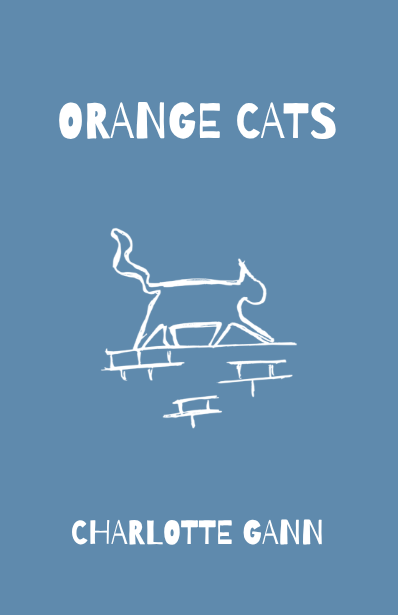
- To order a copy of Orange Cats, please send a message on the Contacts form, and Charlotte will happily be in touch to organise it. The book costs £10 + £2 UK p&p.